
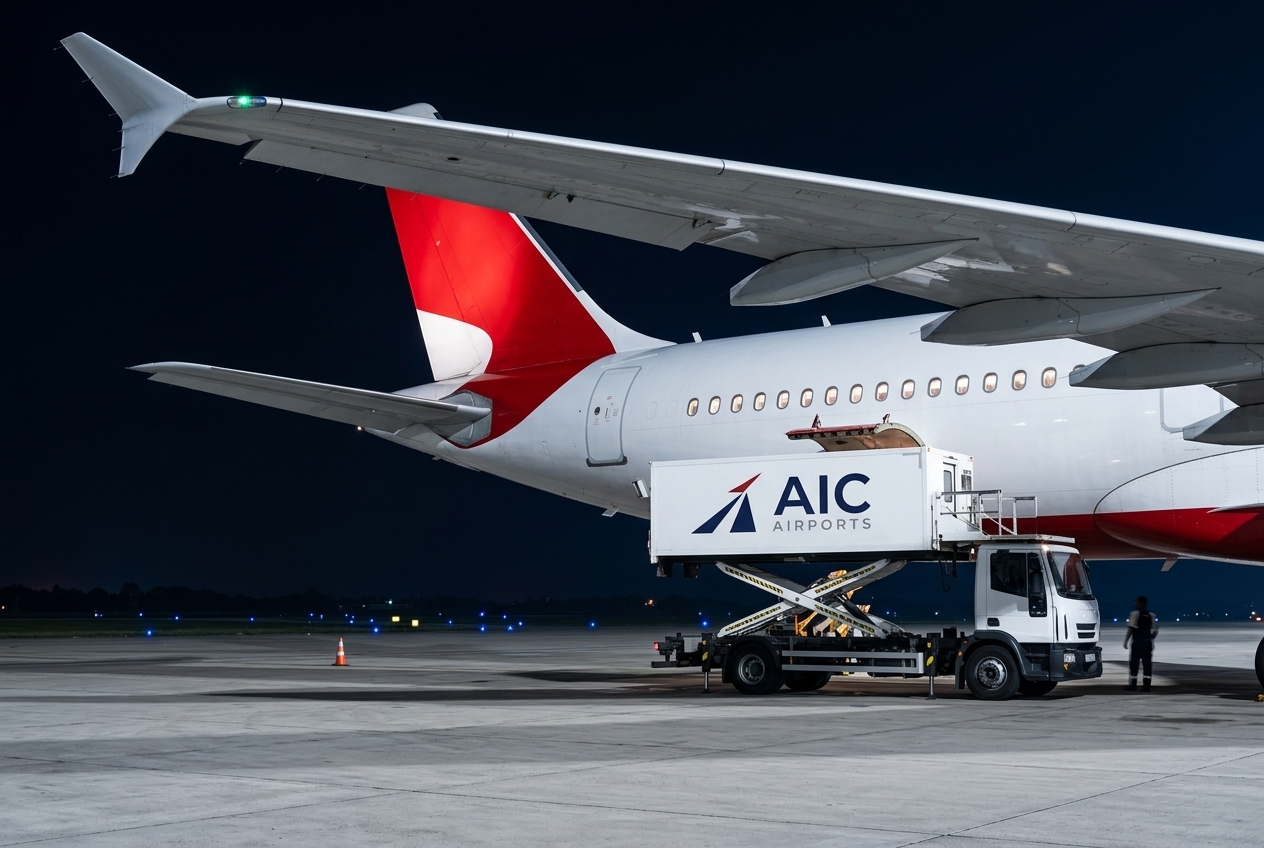
The airport environment
Our sector
Last updatedFrench air traffic has recovered, then passed, its pre-crisis level, but growth here is slower than in the rest of Europe. That moderate momentum comes on top of persistent pressure on operating costs and a steady tightening of regulatory, social and environmental requirements.
For clients, the consequence is direct: ground services are contracted over more tightly defined scopes, with stronger traceability requirements and less tolerance for discrepancy. The question is no longer finding a provider able to do everything, but having providers able to deliver exactly what was written.
Our positioning follows the logic of the market: in a consolidating sector, we are building a solid, approved and dependable operator, serving airlines that need a turnaround partner that is both technical and built to last.
The airport sector sets one of the highest bars there is: time constraints, security standards, the safety of people and aircraft, round-the-clock operations.
AIC AIRPORTS knows these constraints and structures its services to anticipate and meet them.
The figures
-0.8%
in commercial passenger traffic
Air traffic in France
Against the first half of 2025, while remaining 1.1% above its 2019 level. The decline deepens through the half-year: +1.4% in March, -3.2% in April, -1.3% in May, -1.9% in June.
Scope: France
Period: January to June 2026
Source: DGAC, tendanCiel, monthly commercial air traffic indicator No. 154 – June 2026.51.60
million passengers
Paris platforms
Up 0.5% year on year, or 98.6% of the 2019 level.
Scope: Paris-Charles de Gaulle and Paris-Orly
Period: January to June 2026
Source: Groupe ADP, “June and first-half 2026 traffic – revision of traffic assumptions for 2026”.
183
million passengers
Air traffic in France
Up 2.8% year on year and 2.0% on 2019.
Scope: France
Source: Direction générale de l'aviation civile (DGAC), commercial air traffic statistical bulletin – 2025.210.6
million commercial passengers
Traffic at French airports
Around +2.3% year on year, close to 4.7 million additional passengers, and slightly below the 2019 level.
Scope: French airports, mainland and overseas
Sources: Union des aéroports français (UAF), annual review presented on 27 March 2026.
DGAC, 2025 statistical bulletin, “Airports” chapter: 210,590,662 passengers.106.96
million passengers
Paris platforms
Up 3.4% year on year, or 99.0% of the 2019 level.
Scope: Paris-Charles de Gaulle and Paris-Orly
Source: Groupe ADP, annual traffic release “December and full-year 2025 traffic”.
Reading the sector
A market that has levelled off, sharper demands on every turnaround
French air transport is no longer in a catch-up phase. With 210.6 million passengers handled in 2025, French airports remain 1.8% below their 2019 level, and the first half of 2026 is down 0.8% year on year. Groupe ADP has cut its assumption for annual growth in Paris traffic to around 0.5% for 2026.
That levelling off does not reduce the workload on the ground. It shifts its nature: volumes are no longer rising, but requirements on unit cost, punctuality and traceability are tightening.
Fewer movements, heavier turnarounds
This is the defining figure of the period. Commercial movements remain 8.3% below their 2019 level, while passenger numbers are down only 1.8%. The average load has risen from 109 passengers per flight in 2019 to 117 in 2025, and reaches 158 on low-cost flights.
In practice: fewer turnarounds, but each one carries a larger cabin, more seats to service and more equipment to put in place, within slots that are not getting any longer. The value and the criticality of every turnaround rise as their number falls.
The cabin, the last controllable link before boarding
On a short turnaround, cabin preparation sits on the critical path: it governs when boarding can open. A hitch at that stage can no longer be absorbed downstream.
The stake is therefore twofold for our clients. Operational first: beyond three hours' delay on arrival, Regulation (EC) No 261/2004 gives passengers a right to compensation whose cost far exceeds that of the ground service itself. Evidential next: in its decision of 16 May 2024 (Case C-405/23), the Court of Justice of the European Union accepted that a shortage of airport staff may amount to an extraordinary circumstance, but only if the carrier shows that the situation could not have been avoided and that it took the appropriate measures.
That burden of proof is prepared before the incident, not after it. We document every job: timestamp, scope covered, staff assigned, any reservations raised, so that our clients hold evidence they can rely on rather than statements.
A regulated operating framework
Our services on board aircraft fall under category 6 of the ground handling services nomenclature, “aircraft cleaning and servicing”. That classification carries a precise operating framework:
- Ministerial approval. At aerodromes whose annual traffic reaches or exceeds two million passengers or 50,000 tonnes of freight, a provider's activity, like that of its subcontractors, is subject to an approval granted by the minister responsible for civil aviation. The approval is issued by name and lists the aerodromes, the categories of service, the services rendered and the dedicated operating area.
- Authorisation from the airport operator. Each operator maintains an up-to-date list of the providers authorised on its platform and of the carriers they serve.
- Annual reporting. Approved providers file with the authority each year their certified accounts, their certificates of payment of social security and tax contributions, and their certificate of insurance covering the risks of the activity carried out.
- Staff. Our agents come under the national collective agreement for air transport – ground staff, and are subject to the conditions of access to the security restricted area (background check, security clearance, airport identification badge).
- Safety. Safety occurrences are reported under Regulation (EU) No 376/2014.
That framework is a genuine barrier to entry. We treat it as a component of the service, not as an administrative constraint.
Challenges
What is weighing on demand
An economic squeeze that reaches down to ground service buying
Airlines operating in France are absorbing a rise in costs that they pass on only in part. IATA expects the net margin of European carriers to come down from 4.5% in 2025 to 3.1% in 2026, and ticket prices rose by only 5.4% in the second quarter of 2026 despite higher fuel costs. Airport operators are on the same path: Groupe ADP has been running cost-saving measures since March 2026.
That pressure runs all the way down to ground services. Tenders bear less on the overall price than on the cost per turnaround and on the ability to hold it with no observed drop in quality.
An activity that has become discontinuous
In the first half of 2026, Basel-Mulhouse lost 18% of its traffic while its main runway was being resurfaced and Beauvais nearly 7% after a carrier pulled out, while Bordeaux grew by 7.9%.
For a service provider, the issue is no longer growth but the ability to absorb a swing in volume without breaking continuity of service or destabilising cleared teams.
Fewer turnarounds, and heavier ones
The number of commercial movements is still 8.3% below its 2019 level, while passenger numbers are down only 1.8%. The average load has risen from 109 passengers per flight in 2019 to 117 in 2025, and reaches 158 on low-cost flights. The load factor in Paris stands at 83.9% for the first half of 2026.
Fewer turnarounds, but a larger cabin to handle at each one. The constraint is not the same everywhere: at Paris-Orly, at 106.9% of its 2019 level and dominated by short and medium haul, it bears on the individual turnaround; at Paris-Charles de Gaulle, with a transfer rate of 20.7%, it bears on simultaneous load peaks.
What is changing in procurement
Tenders split into lots, which rewards specialised scopes
Clients are breaking their tenders down further. That shift opens access to operators positioned on a precise scope, assessed on that scope rather than on an all-in offer.
It does, however, move the demand onto the definition of the lot. An imprecise scope produces bids that cannot be compared at analysis and discrepancies observed in operation. We systematically set out the content, the limits and the interface points of each lot before committing.
Proof of execution as part of the service itself
The job report has changed status: it is no longer good practice, it is a contractual document.
This change has a direct legal basis. In its decision of 16 May 2024, the Court of Justice of the European Union accepted that a shortage of airport staff may exempt a carrier from its obligation to pay compensation, but only if it shows that the situation could not have been avoided and that it took the appropriate measures. That demonstration rests on material produced before the incident, not after.
For a service provider, the issue is therefore not to have a tracking tool, but to hand back information the client can use in its own management system: time-stamped, tied to a scope and to an operator, and carrying any reservations raised.
What constrains delivery
A workforce whose lead time to access is set by regulation
The difficulty of recruiting and retaining ground staff is not only a matter of unsocial hours. Access to a security restricted area requires a background check, a security clearance and an airport identification badge: a newly recruited agent is not an agent who can be assigned straight away.
That lead time makes team stability an operational variable rather than a comfort argument. It is also framed by the collective agreement for air transport – ground staff, which sets the conditions for the transfer of staff when the provider changes.
Permanent concurrent activity
Several parties working for different employers operate at the same time around the same aircraft or in the same premises, under the operational authority of the airport operator and within the carrier's slots. Coordination is not something added to the organisation of the job: it is what makes it hold.
Environmental and technological requirements now part of the scoring
Environmental criteria are appearing in the scoring grids of tenders and feed into clients' non-financial reporting obligations.
As for digitalisation, service tracking is moving forward: planning, job records, traceability handed back. For a service provider, the issue is to hand back information the client can use in its own management system.
A need? Let's talk.
We reply within 48 working hours. If your need is urgent, say so: we will make it a priority.